
.png)
Disability Gymnastics – Steph’s Story
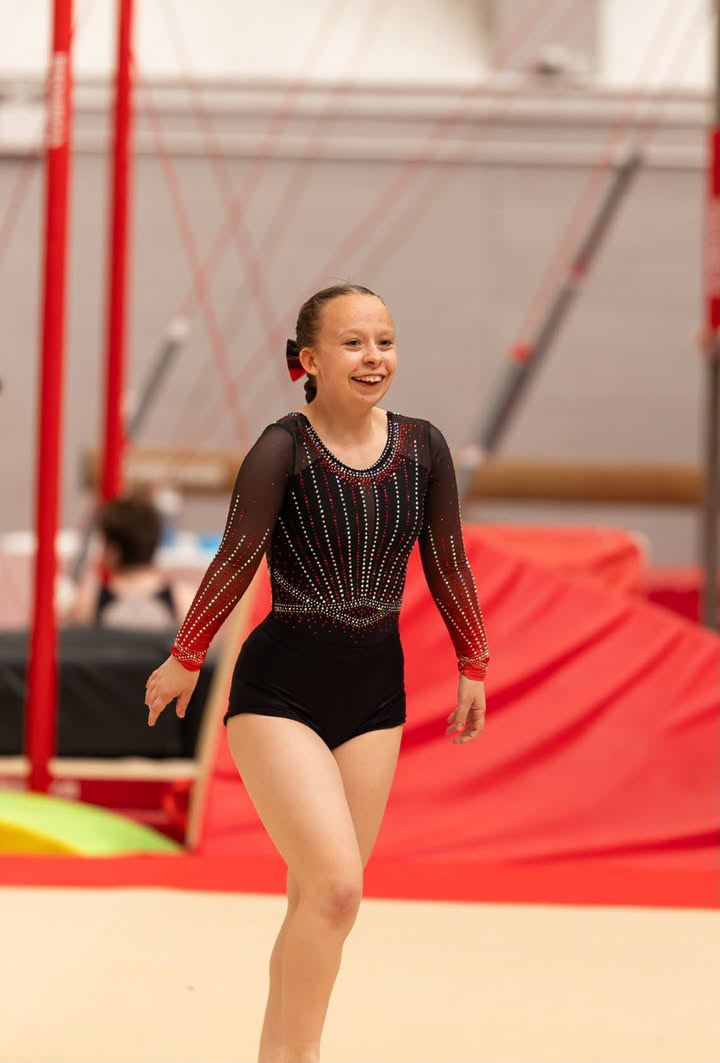
Hey!

My name is Steph, and I am a Paragymnast who has been doing disability gymnastics competitively for 13 years. In that time I have won over 120 medals, competed in five Disability British Championships and helped trial out the Para Gymnastics rules.
I live with Leri-Weill Dyschondrosteosis, which is a rare genetic condition that affects bone growth in the arms, legs and trunk. Because of this, I am shorter than my peers and experience limitations in the length and range of movement in my feet, ankles, legs, arms, hands and shoulders.
I also have Madelung’s Deformity in both of my wrists. This is a condition caused by Leri-Weill Dyschondrosteosis. It affects the shape and function of my wrists - I can’t turn them a certain way or put much pressure on them. I can’t put them flat on the ground at all.
To add even more to this - I have a leg-length discrepancy! This impacts my balance, running, jumping and walking ability.
As you can probably gather, gymnastics is incredibly difficult for me!
What Does Disability Gymnastics Mean to Me?

For me, this isn’t just another discipline. It is my ticket into being able to access a sport that, on paper, I shouldn’t be able to do. It allows me to do what I love - I honestly can’t imagine my life without the sport. Without disability gymnastics, I wouldn’t be doing what I’m doing now.
It has given me a place and an opportunity to grow not just as a gymnast but as a person. I have found my voice through watching as the disability stream changed, and not always for the better. My determination has grown as I faced more and more challenges, but never wavered.
Ultimately, disability gymnastics has given me the feeling that there is a place for me in a sport that I love. I don’t want disability gymnastics to be seen as a watered-down version of gymnastics - I want it to be recognised as what it is - a discipline that provides opportunities that simply would not exist otherwise, allowing more people to do the sport than ever before. No one should have to avoid doing a sport they so sorely want to do, purely because they are disabled.
The Beginning
When I was six years old, I took part in recreational gymnastics lessons. I didn’t last very long though as I struggled to keep up physically with the others and my needs couldn’t be met. I went back to the gymnastics club a couple of years later, where I started recreational disability trampolining, a relatively new class that was being offered. I did this for a while and then, one day, I was the only one who turned up. The coaches took this as an opportunity to test me for their disability gymnastics squad, which was very small and about as new as the trampolining class I was doing.
I couldn’t do much, but they asked me to join anyway. And thus, in the summer of 2013, I started my disability gymnastics journey. I competed in my first competition in October that same year, where I won my first medal. And the rest is history!
Training As A Disability Gymnast
Every area of the sport is affected for me, including conditioning, stretching and even the warm-ups! This means that every training session has to be carefully planned with adaptations and alternative things for me to work on. For example, I am not able to do walkovers or bridges as they place too much pressure on my wrists so when my squad is working on these skills, I work on something else.
Even with these adjustments, training can be difficult. I have to take each session as they come. I will walk into that gym not knowing if I’ll be able to fully train because of pain levels or if I will leave with another injury (usually caused by me trying to push past my body’s limitations). In the last year, I have had six bumped head forms, and most of these have been related to my hands giving way mid-skill.
Because I’m affected in all four of my limbs, I have to put in 110% effort to force my body to do the things that other people find second nature. I won’t stop whilst training, working as hard as I can, taking go after go, pushing myself harder just so I can achieve the same or sometimes even lower results. For example, I could spend an entire session working on a piece of feedback that might take another gymnast only a few attempts, and I still won’t necessarily be able to have fulfilled that feedback.
My progress with skills is never straightforward. Putting my hand ever so slightly wrong on the floor/equipment can injure my hand or arm so much that I won’t be able to attempt the skill for a while afterwards.
Skills might need to be approached in several different ways before we find something that works for me. It can be incredibly frustrating but has taught me to be determined and to never give up. It might take me a while, but the rush I get when I finally do it makes the toil well worth it!
Competing as a Disability Gymnast

My disabilities affect the way I compete in much the same way that it affects my training. The only difference is that in training, especially on bars, I can readjust my hand position and take as long as I need. In competitions, I do not have that luxury. Every readjustment costs me in execution points and the time limits for each piece means I have to push through even if my hands and body aren’t ready.
Because of my limitations, the execution of skills can be affected by something that is caused only by my disabilities rather than my ability as a gymnast, but I get marked down anyway. For example, on bars I can’t straighten my arms because my arms/hands can’t support my body weight, so all my skills are done with bent arms.
This is why having an appropriate, fair and inclusive disability competition pathway is so important to me. I want to be judged on what I am capable of doing and not be penalised for something my body cannot control. For me, the best disability competition is one where I can finish my routines knowing that my score reflects my true capabilities.
The Importance of Para Gymnastics
In May of this year, I competed under the new, developing Para Gymnastics rules. We were scored, received our champion titles and even had routines recorded to help World Gymnastics create the best possible set of rules for people like us. In this competition, I was crowned All Around Champion.
Being the only primarily physically disabled gymnast in my club, I find it pretty isolating as the others in my squad get opportunities I don’t, purely because of what my disability is. Para Gymnastics is the one thing that I would be able to do, and so I see it as the bringer of my sense of belonging - there are others like me and we will get our chance to shine, too. It gives me a pathway. A pathway that I am helping to build through my participation and, hopefully, through blog posts like these.
Para Gymnastics brings visibility that I believe is so important when it comes to disability gymnastics. It’s very easy to spotlight the ones that do the flashiest skills, but in the process those who struggle but still show up and still fight for every routine they perform end up being overlooked, even though their ability to participate says more for the greatness of disability sport than the elite-level skills. Opportunities and inclusion are everything.
And, above all, it challenges people’s idea of what a gymnast looks like. It shows that there isn’t one particular body that belongs in the sport. Disabled people can do whatever sport they want, even if their disabilities mean they are affected in all areas of it.
I want to start Disability Gymnastics. What advice do you have for me?

My biggest piece of advice for someone wanting to start disability gymnastics is… give it a try. Find somewhere that will support you and is understanding of your needs whilst also encouraging you to step out of your comfort zone. An inclusive club and coach can make or break your experience.
I’d also say that it is vital you don’t compare yourself to other gymnasts or put yourself down just because you aren’t getting skills as quickly. As a disabled gymnast, your journey and skills will look different, and that’s okay. It makes you stronger, more determined and more passionate. And all three of these things are what makes a killer athlete.
And, the most important of all: you are a gymnast. Your disability doesn’t make your achievements less real or important, and having to adapt or completely avoid a skill doesn’t make you less of a gymnast. Don’t change yourself or ignore your body’s pains and limitations. Make gymnastics fit you.
Comments